
Deciphering the code on your tyre sidewall is essential for safety, performance, and passing your MOT. Here is everything you need to know.
Whether navigating the narrow streets of Soho, braving the North Circular, or just commuting into the City, your tyres are the only contact point between your vehicle and the road. Ensuring they are the correct size and specification isn’t just about performance; it’s a critical safety issue.
When the time comes to replace them—perhaps after an unfortunate encounter with a London pothole—you need to know exactly what you are looking for.
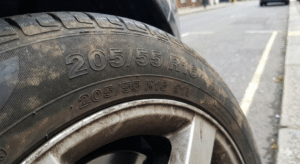
If you look at the side of your tyre (the sidewall), you will see a jumble of numbers and letters. It looks complicated, but it is actually a standardized code. This guide will break down that code so you can buy your next set of tyres with confidence.
Where to Find the Code
Simply look at the sidewall of any of your current tyres. You are looking for the largest, most prominent string of characters.
It will usually look something like this example, which is a very common size for family hatchbacks in the UK:
205/55 R16 91V
Let’s break this example down, section by section.
1. The Width (205)
What it means: 205 millimetres across.
The first number is the width of the tyre measured in millimetres from sidewall to sidewall. In our example, the tyre is 205mm wide. Generally, a wider tyre offers more grip, but can also increase fuel consumption and road noise.
2. The Aspect Ratio / Profile (55)
What it means: The sidewall height is 55% of the width.
This is the part that confuses most people. This number is not a measurement in millimetres; it is a percentage. It represents the height of the tyre’s sidewall from the rim to the tread, expressed as a percentage of the width.
In our example, the sidewall height is 55% of 205mm (which equals roughly 112.75mm).
Lower numbers (e.g., 40 or 35): These are “low profile” tyres. They look sportier and offer better handling feedback but usually result in a firmer ride over bumps.
Higher numbers (e.g., 60 or 65): These have taller sidewalls, offering more cushioning and comfort, common on SUVs or standard city cars.
3. Construction Type (R)
What it means: Radial construction.
This letter tells you how the tyre was built internally. Almost every car tyre sold in the UK today is an ‘R’ for Radial. This means the internal ply cords run radially across the tyre (at 90 degrees to the direction of travel). You might occasionally see ‘B’ (Bias Belt) or ‘D’ (Diagonal) on vintage cars, but ‘R’ is the standard.
4. Rim Diameter (16)
What it means: It fits a 16-inch wheel rim.
This number indicates the diameter of the metal wheel that the tyre is designed to fit onto. Confusingly, while the tyre width is measured in metric millimetres, the rim diameter is always measured in imperial inches.
5. The Load Index (91)
What it means: The maximum weight the tyre can carry.
This is a numerical code that corresponds to a specific weight in kilograms. It does not mean the tyre can carry 91kg. You need to look at a Load Index table to find the actual weight.
A load index of 91 means the tyre can carry a maximum load of 615kg.
Crucial Safety Tip: Never fit tyres with a lower load index than recommended by your vehicle manufacturer. Doing so can overload the tyre, leading to a blowout.
6. The Speed Rating (V)
What it means: The maximum safe speed for the tyre.
The final letter indicates the maximum speed the tyre is legally approved for when carrying its full load capacity.
T = Up to 118 mph (190 km/h)
H = Up to 130 mph (210 km/h)
V = Up to 149 mph (240 km/h)
W = Up to 168 mph (270 km/h)
Y = Up to 186 mph (300 km/h)
While you are unlikely to hit 149 mph on the M25, it is vital to match or exceed the speed rating specified by your car’s manufacturer to ensure the tyre can handle the vehicle’s performance capabilities.
Why This Matters for London Drivers
Fitting the wrong size or specification of tyre isn’t just inconvenient; it can have serious consequences:
MOT Failure: If your tyres are not deemed suitable for the vehicle (e.g., incorrect load rating), your car can fail its MOT.
Insurance Void: If you have an accident and are found to have incorrect tyres fitted, your insurer may invalidate your claim.
Safety and Handling: Your car’s suspension and braking systems were engineered around a specific tyre size. Changing this can negatively affect stopping distances and handling in wet London weather.
Summary
The next time you need to order tyres online or visit a garage, take a photo of your sidewall first. Knowing your Width, Profile, Rim Size, Load Index, and Speed Rating ensures you get the perfect match for your vehicle, keeping you safe on the capital’s roads.